
How to Test a Capacitor with a Multimeter
Learn several reliable methods to check electrolytic and ceramic capacitors using a multimeter and other practical tests.
Introduction
Capacitors are used throughout electronic circuits for filtering, coupling, decoupling, timing and energy storage. When a capacitor fails, it can cause symptoms such as hum, unstable voltage, distortion, overheating or complete circuit failure.
A digital multimeter can perform several useful tests that help determine whether a capacitor is likely to be faulty. However, no single test can identify every possible capacitor failure.
1. Safety First
Always switch off and unplug the equipment before testing a capacitor. Large capacitors can retain a dangerous electrical charge even after the equipment has been disconnected from the power source.
Before measuring a capacitor, discharge it using an appropriate method. Never assume that a large electrolytic capacitor is discharged simply because the equipment has been switched off.
2. Inspect the Capacitor
Before using the multimeter, inspect the capacitor carefully.
- Look for a bulging top on electrolytic capacitors.
- Check for leakage or damaged insulation.
- Look for cracked or damaged bodies.
- Check for burned or discolored components.
- Inspect the leads and solder joints.
A visibly damaged capacitor should be treated as suspicious even before electrical measurements are made.
3. Testing Capacitance with a Multimeter
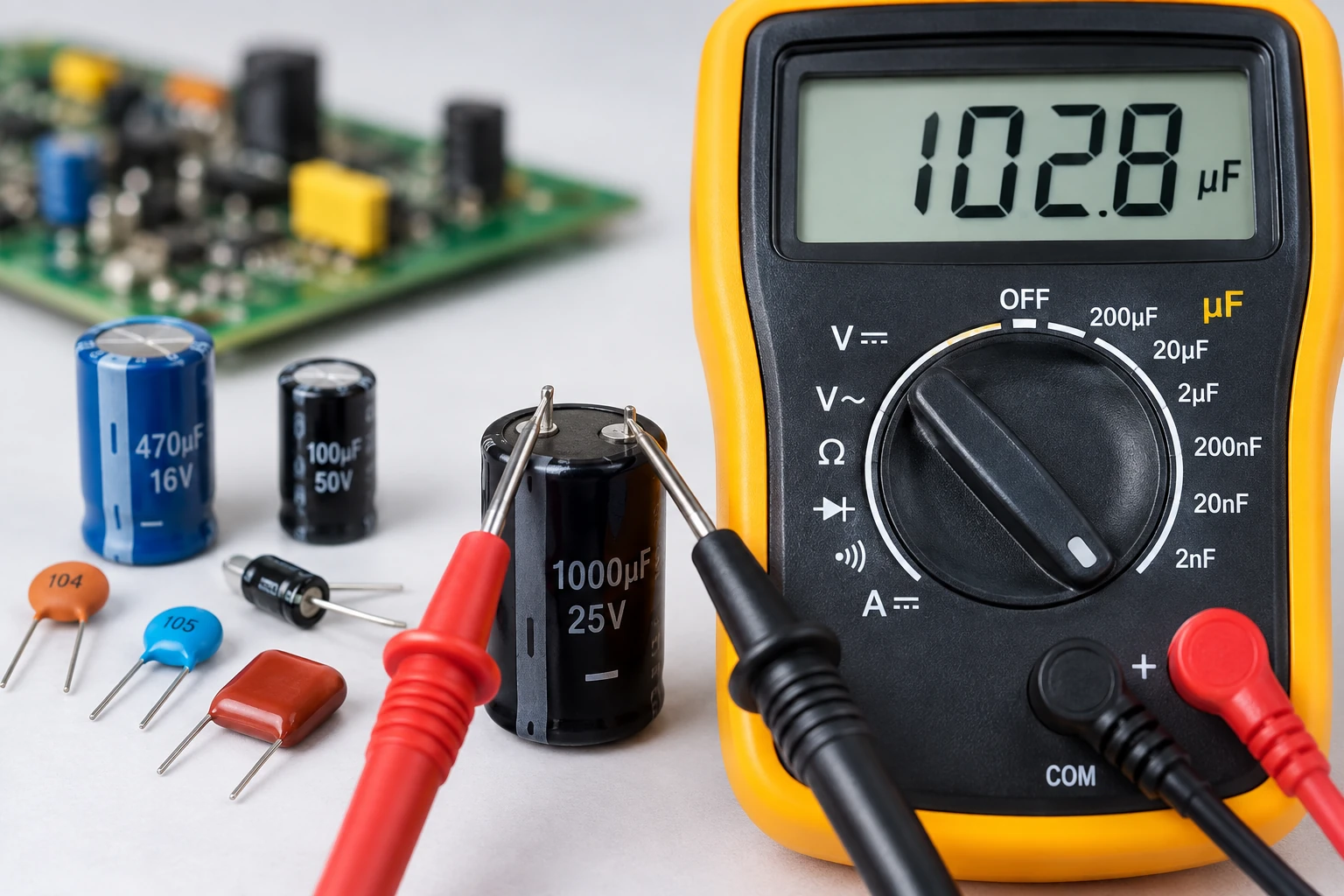
Many modern digital multimeters have a capacitance measurement function. This is one of the easiest ways to check whether a capacitor is close to its rated capacitance.
First disconnect the capacitor from the circuit or remove at least one lead. Measuring a capacitor while it is connected to other components can produce an incorrect reading.
Set the multimeter to capacitance mode and connect the probes to the capacitor terminals.
For a polarized electrolytic capacitor, observe the polarity indicated on the capacitor and follow the polarity requirements of the meter.
Compare the measured value with the capacitance printed on the capacitor and consider its specified tolerance.
4. Testing a Capacitor with Resistance Mode
If your multimeter does not have a capacitance function, resistance mode can provide a useful basic test.
Set the meter to a suitable resistance range and connect the probes across the discharged capacitor.
A capacitor may initially show a relatively low resistance and then the display may move toward a higher resistance as the capacitor charges from the meter's test voltage.
The exact behavior depends on the capacitor, the meter and the measurement range, so this test should be considered a basic indication rather than a complete capacitor test.
5. What Different Readings Can Indicate
| Observation | Possible indication |
|---|---|
| Capacitance close to rated value | Capacitance appears normal |
| Very low or zero capacitance | Possible open or severely degraded capacitor |
| Resistance remains very low | Possible shorted capacitor |
| Resistance rises toward a high value | Typical charging behavior in a basic resistance test |
These observations are useful diagnostic clues, but they do not replace specialized tests when the condition of the capacitor is important.
6. Testing Electrolytic Capacitors
Electrolytic capacitors require particular attention because they are polarized and can develop several different types of faults.
A capacitor may still measure close to its nominal capacitance while having excessive leakage or ESR. This is why capacitance measurement alone cannot always determine whether an electrolytic capacitor is suitable for use in a circuit.
7. ESR Testing
An ESR meter can provide additional information about the condition of an electrolytic capacitor.
In power supplies and audio equipment, a capacitor with excessive ESR can cause increased ripple, voltage instability and other circuit problems.
For repair work involving switching power supplies, amplifiers and other equipment containing electrolytic capacitors, an ESR meter can therefore be a useful addition to a multimeter.
8. Testing Capacitors In Circuit
Testing a capacitor while it is still installed in a circuit can be misleading because other components connected to it can affect the meter reading.
For a more reliable measurement, disconnect the capacitor from the circuit or remove at least one terminal when practical.
9. Ceramic and Film Capacitors
Ceramic and film capacitors can also be checked using a capacitance function when the meter supports it.
Unlike polarized electrolytic capacitors, many ceramic and film capacitors do not have a positive and negative terminal.
A capacitance measurement should be compared with the component's marked value and tolerance.
10. Important Limitations
A multimeter is a useful first diagnostic tool, but it cannot detect every capacitor problem.
A capacitor can have approximately the correct capacitance while suffering from excessive ESR, leakage or problems that only appear under operating voltage or temperature.
When troubleshooting a circuit, always consider the capacitor's role in the circuit and compare measurements with the expected circuit voltages and behavior.
Conclusion
Testing a capacitor with a multimeter is a useful skill for electronics repair. Capacitance measurement can reveal obvious changes in value, while resistance testing can provide additional clues when a capacitance range is unavailable.
For electrolytic capacitors used in demanding applications, ESR and leakage measurements may provide information that a basic multimeter cannot.
A good capacitor test therefore combines visual inspection, electrical measurements and an understanding of the circuit in which the component is being used.