
Resistor Types Explained
Resistors are among the most common components in electronics. Different resistor constructions are designed for different applications, power levels and accuracy requirements.
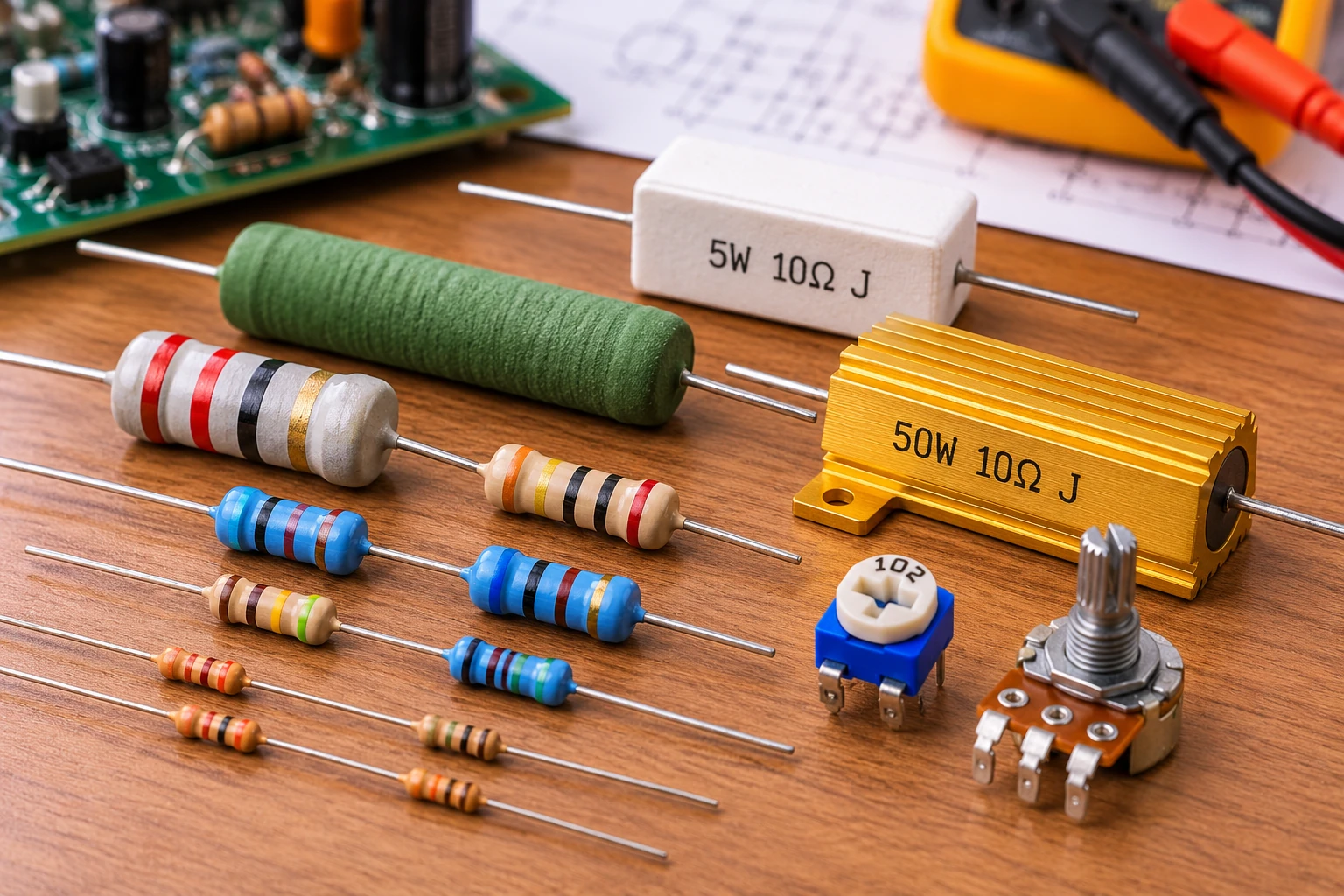
What Is a Resistor?
A resistor is a passive electronic component that opposes the flow of electric current. Its resistance is measured in ohms (Ω).
Resistors are used for current limiting, voltage division, biasing, signal conditioning, feedback and many other electronic functions.
Carbon Film Resistors
Carbon film resistors are common general-purpose components. They are inexpensive and suitable for many low-power electronic circuits.
Metal Film Resistors
Metal film resistors generally provide better tolerance and stability than many basic carbon film resistors. They are commonly used where more accurate resistance values are useful.
Wirewound Resistors
Wirewound resistors are made by winding resistance wire around a suitable core. They can be manufactured for relatively high power levels and are useful in applications where significant heat must be handled.
Power Resistors
Power resistors are designed to dissipate more heat than ordinary small signal resistors. They may be physically larger and are often used in power supplies, amplifiers, motor circuits and load banks.
Variable Resistors
Variable resistors allow their resistance to be adjusted. Potentiometers and trimmer potentiometers are common examples.
Potentiometers are frequently used as volume controls, adjustment controls and voltage dividers.
Resistor Tolerance
Tolerance specifies how much the actual resistance can differ from the nominal marked value.
For example, a 1 kΩ resistor with 5% tolerance can have an actual resistance within the specified tolerance range around 1 kΩ.
Power Rating
The power rating indicates how much electrical power the resistor can dissipate under its specified conditions.
The basic resistor power relationship is:
P = I²R
and also:
P = V²/R
Common Resistor Types
| Type | Typical Use |
|---|---|
| Carbon film | General-purpose circuits |
| Metal film | Accurate and stable circuits |
| Wirewound | Higher-power applications |
| Power resistor | High heat dissipation |
| Potentiometer | Adjustable resistance |
| Trimmer | Calibration and adjustment |
Conclusion
Choosing a resistor involves more than selecting the resistance value. The resistor type, tolerance, power rating, physical size and application should all be considered.