
Power Supply Troubleshooting Guide
A systematic approach makes power supply troubleshooting much easier. This guide explains how to check the main stages of a typical electronic power supply and locate common faults.
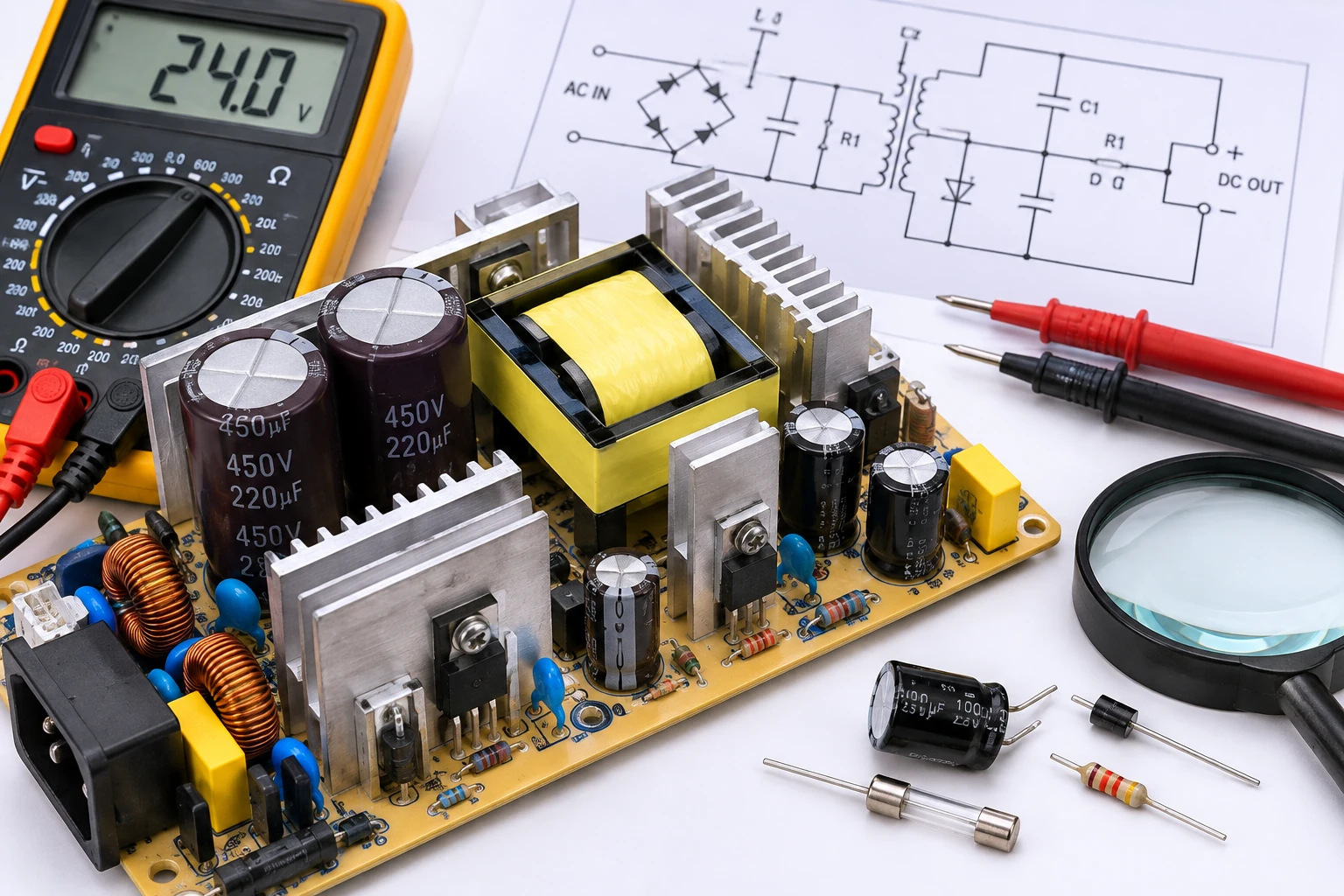
Safety First
Power supplies can contain dangerous voltages even after the equipment has been switched off. Large capacitors may remain charged.
Never work inside mains-powered equipment unless you understand the hazards and have appropriate test equipment and safety procedures.
Start With a Visual Inspection
Before applying power, inspect the board carefully. Look for burned components, cracked solder joints, damaged tracks, swollen capacitors, broken wires and blown fuses.
Check the Fuse
A blown fuse is often the first indication of a power supply fault. Do not simply replace a repeatedly blown fuse with a larger fuse.
A fuse that blows again usually indicates another problem such as a shorted rectifier, transistor, MOSFET, capacitor or transformer.
Check the Transformer
In transformer-based supplies, check the transformer windings and connections before proceeding to the rectifier stage.
Resistance measurements can help identify an open winding, but a resistance test alone cannot prove that a transformer is operating correctly under load.
Check the Rectifier
A bridge rectifier converts AC into pulsating DC. Individual diodes can be tested with the diode-test function of a multimeter when the circuit is safely disconnected.
Check the Filter Capacitors
Large electrolytic capacitors smooth the rectified voltage. A failed capacitor can cause excessive ripple, low output voltage or unstable operation.
Capacitance, ESR and visual inspection can all provide useful information when diagnosing electrolytic capacitors.
Check the Regulator
Linear and switching regulators control the output voltage. Measure the input and output voltages according to the circuit design.
If the input voltage is correct but the output is missing, the regulator or another component connected to its output may be faulty.
Work Through the Circuit Stage by Stage
| Stage | What to Check |
|---|---|
| Input | Mains, connector, switch and fuse |
| Transformer | Primary and secondary windings |
| Rectifier | Diodes and bridge rectifier |
| Filter | Electrolytic capacitors and ripple |
| Regulator | Input, output and control signals |
| Load | Short circuits and excessive current |
Conclusion
The safest and most effective troubleshooting method is to divide the power supply into stages and test each stage systematically. Avoid replacing components randomly; measurements can usually narrow down the faulty section first.