
Speaker Voice Coil Basics
The voice coil is the part of a loudspeaker that converts electrical energy from the amplifier into mechanical movement. Understanding the voice coil is essential for speaker repair and design.
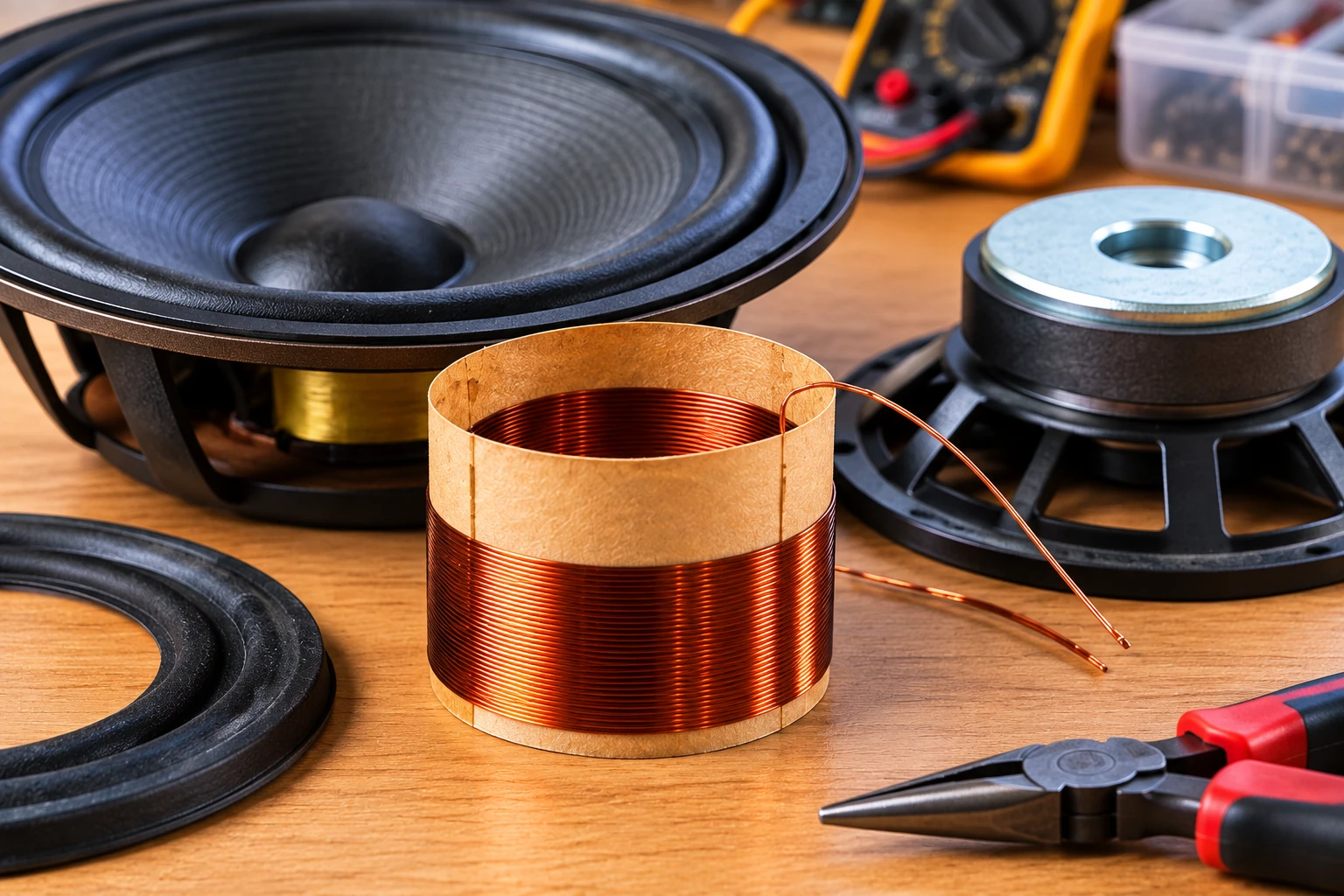
What Is a Voice Coil?
A voice coil is a coil of wire attached to the speaker diaphragm, cone or former. It sits inside the magnetic field created by the speaker's permanent magnet.
When an audio signal flows through the coil, the interaction between the current and magnetic field produces a force. This moves the cone and creates sound.
Voice Coil Construction
A typical voice coil consists of fine insulated wire wound around a cylindrical former. The former is connected mechanically to the speaker cone and suspension system.
The wire size, number of turns, former material and winding dimensions all affect the electrical and mechanical characteristics of the speaker.
Voice Coil Impedance
Speaker voice coils are commonly specified with nominal impedances such as 4 ohms, 6 ohms or 8 ohms.
The DC resistance measured with a multimeter will normally be lower than the nominal impedance because impedance also includes the frequency-dependent behavior of the coil.
Testing a Voice Coil
A basic test can be performed using a multimeter set to resistance. Disconnect the speaker from the amplifier before testing.
- A very low resistance may indicate a shorted coil.
- An open circuit may indicate a broken voice coil.
- A normal DC resistance does not guarantee that the speaker is mechanically healthy.
Common Voice Coil Problems
- Open or broken winding
- Shorted winding
- Burned or overheated wire
- Voice coil rubbing against the pole piece
- Loose connection between coil and lead wire
- Damaged former
Voice Coil Rubbing
A damaged or misaligned voice coil can rub against the magnetic gap. This can produce scratching or buzzing sounds when the cone is moved.
With the amplifier disconnected, gently move the cone by hand. A healthy speaker should normally move smoothly without a scraping sound.
Conclusion
The voice coil is one of the most important parts of a loudspeaker. Understanding its construction, resistance, impedance and common failures makes speaker troubleshooting much easier.