
Build a Professional PA Power Amplifier
Professional Public Address (PA) amplifiers are designed to deliver large amounts of clean audio power for concerts, churches, schools, auditoriums, DJ systems and outdoor events. Unlike home Hi-Fi amplifiers, PA amplifiers must withstand continuous operation at high power while maintaining excellent reliability and sound quality. This project explains the design and construction of a modern high-power Class AB PA amplifier capable of delivering several hundred watts per channel.
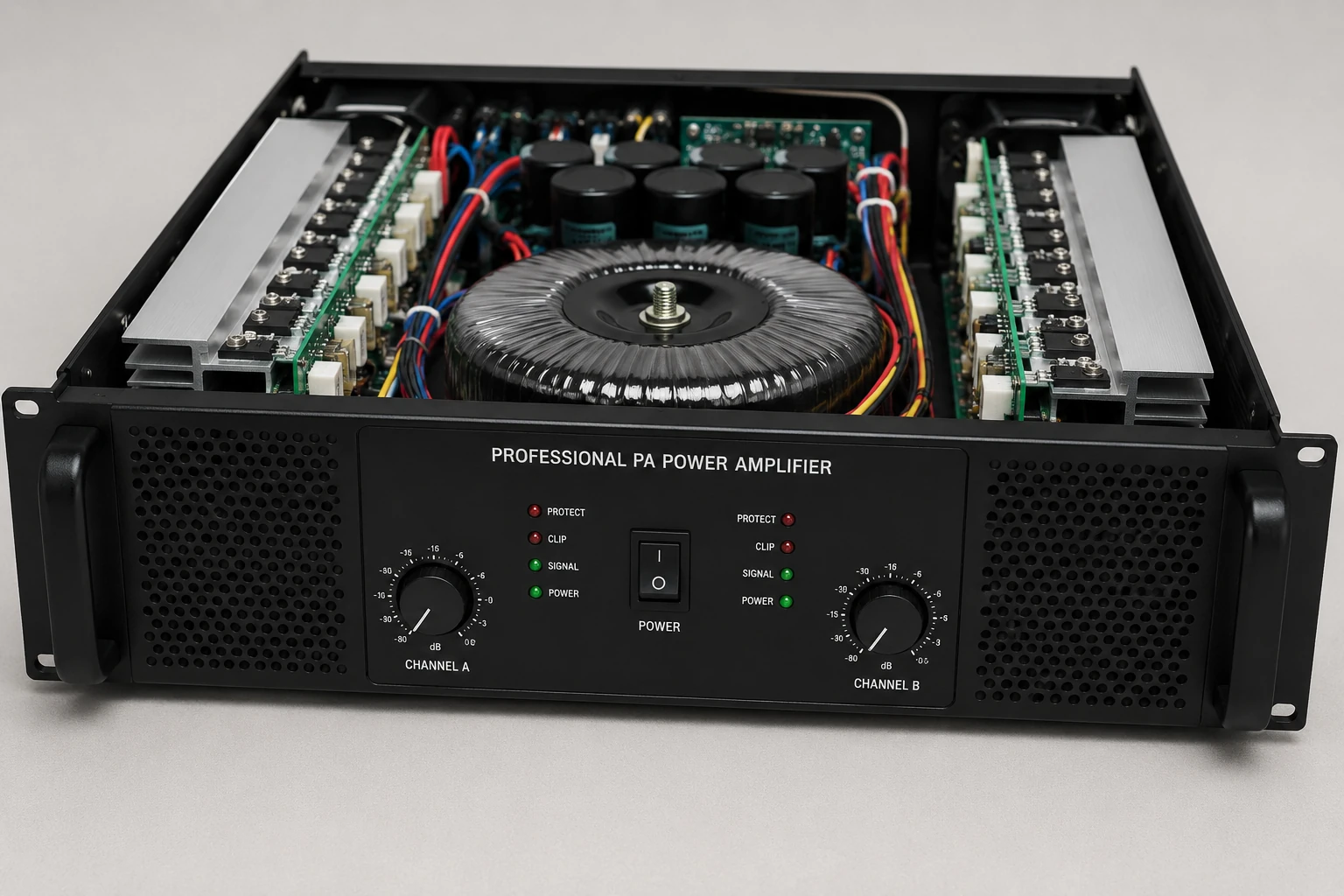
Project Overview
A professional PA amplifier consists of several functional blocks working together to deliver clean, powerful audio.
- Balanced audio input.
- Differential input amplifier.
- Voltage amplifier stage (VAS).
- Bias circuit.
- Driver stage.
- Multiple complementary output transistors.
- Speaker protection.
- Cooling system.
Project Difficulty
| Item | Value |
|---|---|
| Difficulty | ⭐⭐⭐⭐⭐ Professional |
| Build Time | 2–5 Days |
| Supply Voltage | ±50 V to ±95 V DC |
| Output Power | 300–1500 Watts |
| Soldering | Essential |
Typical Components
| Component | Typical Choice |
|---|---|
| Differential Pair | 2SA970 / BC556 |
| VAS | 2SC2240 / BC546 |
| Bias Transistor | BD139 / D669 |
| Driver Transistors | 2SC4793 / 2SA1837 |
| Output Transistors | 2SC5200 / 2SA1943 (4–16 pairs) |
| Emitter Resistors | 0.22 Ω / 5 W |
| Transformer | 800–3000 VA Toroidal |
| Bridge Rectifier | 35–100 A |
| Filter Capacitors | 10,000–22,000 µF per rail |
Amplifier Stages
| Stage | Purpose |
|---|---|
| Input Differential Amplifier | Amplifies the incoming audio signal. |
| Current Mirror | Improves gain and stability. |
| Voltage Amplifier Stage | Provides most of the voltage amplification. |
| Bias Circuit | Reduces crossover distortion. |
| Driver Stage | Supplies base current to the power transistors. |
| Output Stage | Delivers high current to the loudspeaker. |
| Negative Feedback | Improves linearity and reduces distortion. |
Power Supply
Professional PA amplifiers require powerful dual-rail power supplies with excellent regulation and filtering.
| Amplifier Power | Transformer | Supply |
|---|---|---|
| 300 W | 800 VA | ±55 V |
| 500 W | 1200 VA | ±70 V |
| 800 W | 2000 VA | ±80 V |
| 1200 W | 3000 VA | ±90 V |
Cooling System
High-power amplifiers generate significant heat. Proper cooling is critical for long-term reliability.
- Large extruded aluminium heat sinks.
- High-airflow cooling fans.
- Temperature-controlled fan speed.
- Thermal sensors.
- Ventilated chassis.
Protection Circuits
- Speaker protection relay.
- Power-on delay.
- DC offset detection.
- Short-circuit protection.
- Thermal shutdown.
- Over-current limiting.
- Soft-start for large transformers.
- Clip limiter.
Applications
- Concert sound systems.
- Church audio installations.
- DJ sound systems.
- Auditoriums.
- Conference halls.
- Outdoor events.
- Nightclubs.
- Cinema sound systems.
Testing Procedure
- Inspect every PCB carefully.
- Verify transistor orientation.
- Measure resistance between supply rails.
- Power up using a dim-bulb tester.
- Measure DC offset.
- Adjust the bias current.
- Test using an 8 Ω dummy load.
- Inject a 1 kHz sine wave.
- Monitor the waveform with an oscilloscope.
- Perform a long-duration power test while monitoring heat sink temperature.
Troubleshooting
| Problem | Possible Cause |
|---|---|
| No output | Power supply or protection circuit fault. |
| Amplifier overheats | Incorrect bias or inadequate cooling. |
| Distorted audio | Faulty driver or output transistor. |
| Protection relay does not engage | DC offset detected or relay driver fault. |
| Hum | Poor grounding or insufficient power supply filtering. |
| Amplifier oscillates | Poor PCB layout or missing compensation components. |
Project Improvements
- Balanced XLR inputs.
- Bridge-mode operation.
- Stereo/Parallel/Bridge switching.
- LCD temperature display.
- DSP speaker management.
- Digital clip limiter.
- Power meter.
- Network remote monitoring.
Skills Learned
- High-power amplifier design.
- Thermal management.
- Power supply construction.
- Protection circuit implementation.
- Professional amplifier testing.
- Large-scale PCB assembly.
Safety Notes
- These amplifiers contain hazardous mains and high DC voltages.
- Always discharge filter capacitors before servicing.
- Use correctly rated fuses for both the mains input and DC rails.
- Ensure the metal chassis is properly earthed.
- Perform initial testing with a current limiter or dim-bulb tester.
- Do not connect expensive loudspeakers until the amplifier has been thoroughly tested.
Key Points
- Professional PA amplifiers are designed for continuous high-power operation.
- Reliable cooling and protection circuits are just as important as the amplifier itself.
- A stable, high-current power supply is essential for maximum performance.
- Careful PCB layout and grounding minimise distortion and unwanted noise.
- A well-designed PA amplifier can provide years of dependable service in demanding environments.